
Reforming Essential Skills Wales Qualifications
English | Cymraeg
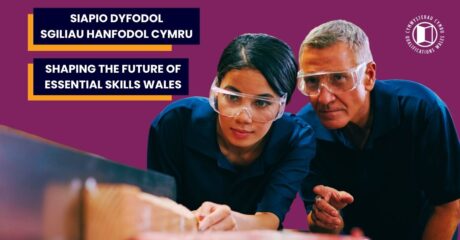
Qualifications Wales recently published its findings and decisions report after its consultation process on reforming Essential Skills Wales qualifications in Application of Number, Communication and Digital Literacy. Senior Qualifications Manager Oliver Stacey takes us through the decisions and the next steps.
The importance of ESW
Essential Skills Wales (ESW) qualifications are a significant and important component of the qualifications landscape. As a suite they are among the most widely certified qualifications in Wales. They are a cornerstone of apprenticeship frameworks and are taken by many learners in post-16 settings as alternatives to GCSE resits.
These qualifications enable learners to develop essential transferable numeracy, literacy and digital skills needed for life, learning and work.
Why we are reforming ESW
Following an in-depth review into Essential Skills Wales, we are reforming the qualifications to ensure they remain relevant and engaging as well as manageable for centres to deliver and learners to complete.
Our review identified many positive aspects to the existing ESW qualifications. However, there were a number of areas where stakeholders highlighted opportunities to strengthen the qualifications even further, particularly in relation to the:
- relevance of the content
- duration of the assessments
- manageability of the assessments
- progression between levels
In developing our proposals for the reformed qualifications, our priority has been to address these aspects of the qualifications. We engaged extensively with a range of stakeholders with an interest in these qualifications. A wide variety of perspectives were expressed around ESW, which is not surprising given the diverse range of environments in which these qualifications are delivered. Our proposals sought to balance these differing perspectives.
Shaping the future of ESW
Between November 2025 and February of this year we consulted on the design requirements for revised ESW qualifications in the areas of numeracy, literacy and digital. Our proposals included the following.
Reducing the overall assessment time
To achieve reducing the overall assessment time at levels 1 and 2 across all three subject areas to address concerns around the manageability of the assessments, we proposed increasing the proportion of external assessment. This would also reduce the amount of marking and moderation that centres are required to undertake, thereby reducing tutor workload.
Clearer progression in content between levels
For example, within the literacy qualification, we proposed having more explicit statements around the required level of proficiency in spelling, punctuation and grammar at each level of the qualification to help differentiate more clearly between the levels.
More up-to-date content
For example, in numeracy we proposed including more financial mathematics within the qualification, and within the digital qualification more consideration around artificial intelligence.
Use of calculators
Within the numeracy qualification, we proposed that the majority of questions in the assessments at level 1 and 2 should permit the use of a calculator.
Changes to qualification titles
To better reflect the content of the qualifications and to clearly signal a change in the qualifications, we proposed changing the qualification titles from Application of Number to Numeracy, Digital Literacy to Digital and Communication to Literacy.
Removing ESW qualifications at Level 3 and Entry 1 and 2 in Digital from the ESW suite
Our decisions following the consultation
We had a favourable response to our consultation in terms of the number of people replying. This included over 700 submissions from learners. There was broad support for our consultation proposals from both learners and other respondents, with many people expressing positive views around our focus on improving the manageability of the qualifications for both centres and learners.
Therefore, in most instances we have decided to proceed with our consultation proposals. However, based on consultation feedback we have:
- made minor revisions to content by including additional detail to improve clarity
- changed the assessment structure for Literacy at Levels 1 and 2 by splitting the assessment of reading and writing into separate assessments
- required awarding bodies, across all subjects, to provide at least one externally produced assessment for each entry level qualification
Read more about our consultation findings and decisions.
Next steps in the process
Given the status of ESW qualifications, any awarding body who wishes to deliver them will be required to undertake a recognition process first. This is to give us, as the regulator, sufficient assurance that they have the expertise, capacity and capability to deliver and award these qualifications for the lifetime of the qualification. Once awarding bodies have obtained recognition, they will be able to start developing the qualifications and submitting them to us for approval.
The intention is that the new qualifications will be available from September 2028, with specifications and sample assessment materials available well in advance of first teaching to give learning providers sufficient time to plan and prepare for delivery.
We will be engaging closely with learning providers, awarding bodies and other key stakeholders, such as Medr and Welsh Government, as we undertake change management activities to support the introduction of the new qualifications and the smooth transition from the legacy qualifications. This will include considering how long both the legacy and new versions of the qualifications will run alongside each other.
We look forward to working with NTFW and the work-based learning sector between now and September 2028 to help realise the full benefits of these reforms.
More News Articles
« Leadership development helping school leaders strengthen inclusive practice across North Wales — Unlocking Potential and Building Workforce Readiness »


